
Every major LLM — ChatGPT, Claude, Copilot, Gemini — is already strong enough to deliver the efficiency improvements your company is looking for. The problem isn't the models. The problem is "on our end."
We increasingly hear from clients and partners who start an AI implementation initiative with genuine enthusiasm. Energy builds, a few people begin experimenting — and then, a few weeks later, the momentum quietly disappears. Everyone else returns to their usual workflows. Six months on, the initiative is a conversation that goes nowhere.
We really need to get back to the AI rollout... but there's never time.
What is an AI adoption strategy? An AI adoption strategy is a structured plan for embedding artificial intelligence into your organization's workflows — covering process analysis, people development, and change management. Without one, most AI initiatives produce short bursts of enthusiasm and little lasting change.
This is the default trajectory when AI adoption runs without structure. And the fix isn't a new tool or a bigger budget. It's a proper project management approach.
AI Adoption Is a Transformation — Not Just a Training Problem
Most organizations approach AI adoption as a training problem: give people access, run a few workshops, and wait for usage to spread. This works about as well as handing everyone a gym membership and expecting them to get fit.
The reality is that successful AI adoption is a multi-layered undertaking — one that combines three distinct elements.
Process review and optimization. AI doesn't fix poorly organized processes on its own. You need to understand how your organization works today before deciding where AI can add genuine value.
AI Literacy. Not everyone is at the same level when it comes to working with AI. Some people are just getting started. Others are already doing sophisticated things. You need to know where your team stands in order to know which direction to develop them.
Change Management. Even with the right processes and trained people, you still need to manage the transition: how you move from the old way of working to the new one — and how you make sure the change sticks.
These three elements together aren't a job for a single workshop. You need clearly defined goals, ownership, deliberate measurement, and structured iteration. It's a multi-layered undertaking. In other words: a project.
What You Lose Without a Structured AI Adoption Strategy
Before we talk about the framework, there's a more fundamental problem: without structure, you don't even know where to start. AI training for everyone? Reviewing processes in finance? Building a custom SKILL for writing marketing materials? Each option sounds reasonable. But without a baseline, you can't meaningfully prioritize any of them.
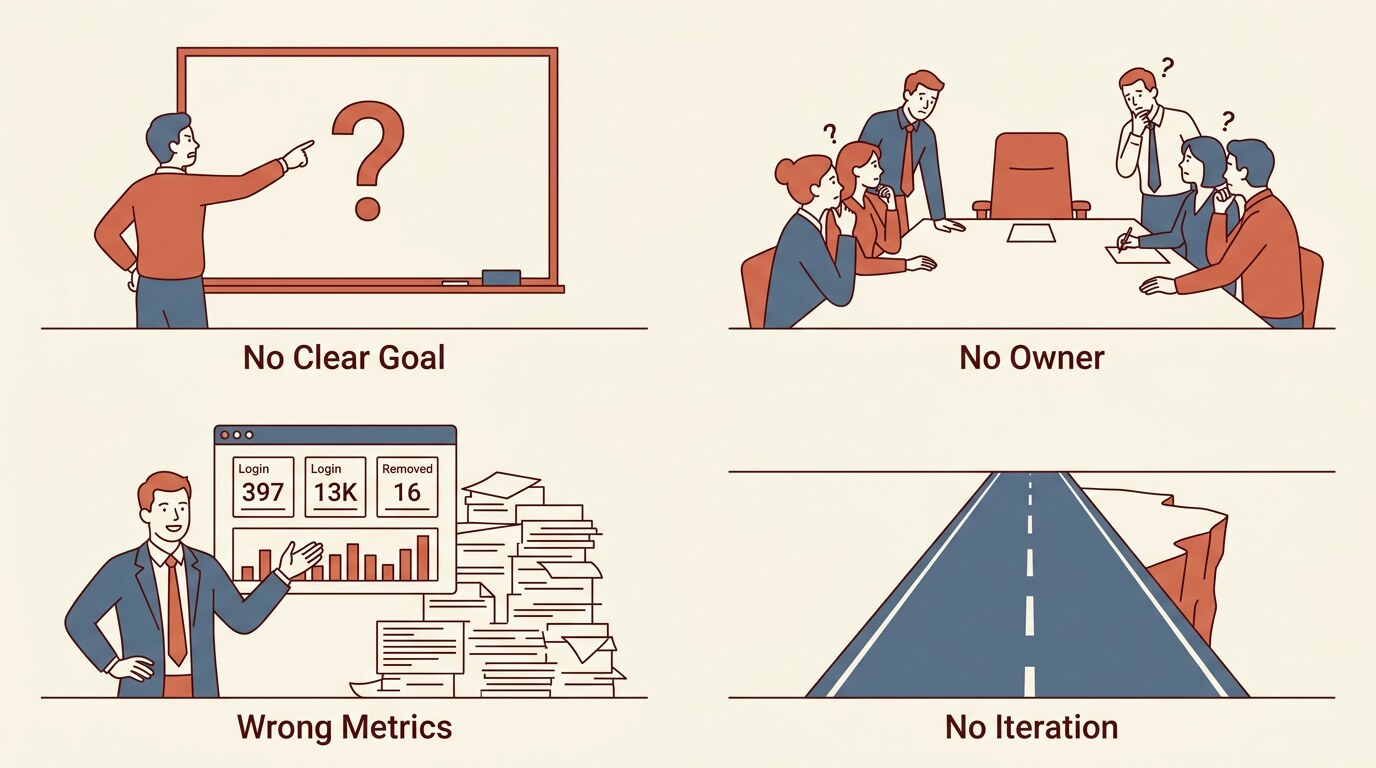
No defined outcome. "Use AI more" isn't a goal — it's a direction with no destination. Without a specific, measurable outcome, there's no way to know whether you're succeeding or just spending more time in ChatGPT (or Claude, Copilot, or Gemini — whichever tool your company uses).
No ownership. When everyone is responsible, no one is. AI adoption needs a single named person driving it — not a committee, not a working group. One person. A name. Someone accountable.
When everyone is responsible, no one is. You need one specific person — not a committee, not a working group.
No measurement of what matters. Login statistics and usage dashboards tell you who opened the tool. They don't tell you whether anything changed. Effective measurement tracks behavior: are workflows actually shifting? Are people reaching for AI at the right moments in their work?
No iteration. Most teams treat week four of an AI initiative as an endpoint. It should be a sprint retrospective. What worked? What didn't? What's the next priority? Without built-in iteration, even strong starts tend to plateau.
These aren't AI-specific failure modes. They're the same reasons any change initiative stalls. Which is exactly why the solution is the same: project structure.
A Framework for Running AI Adoption as a Project
Running AI adoption as a project doesn't mean a 40-slide charter. It means applying the fundamentals that make any change initiative work.
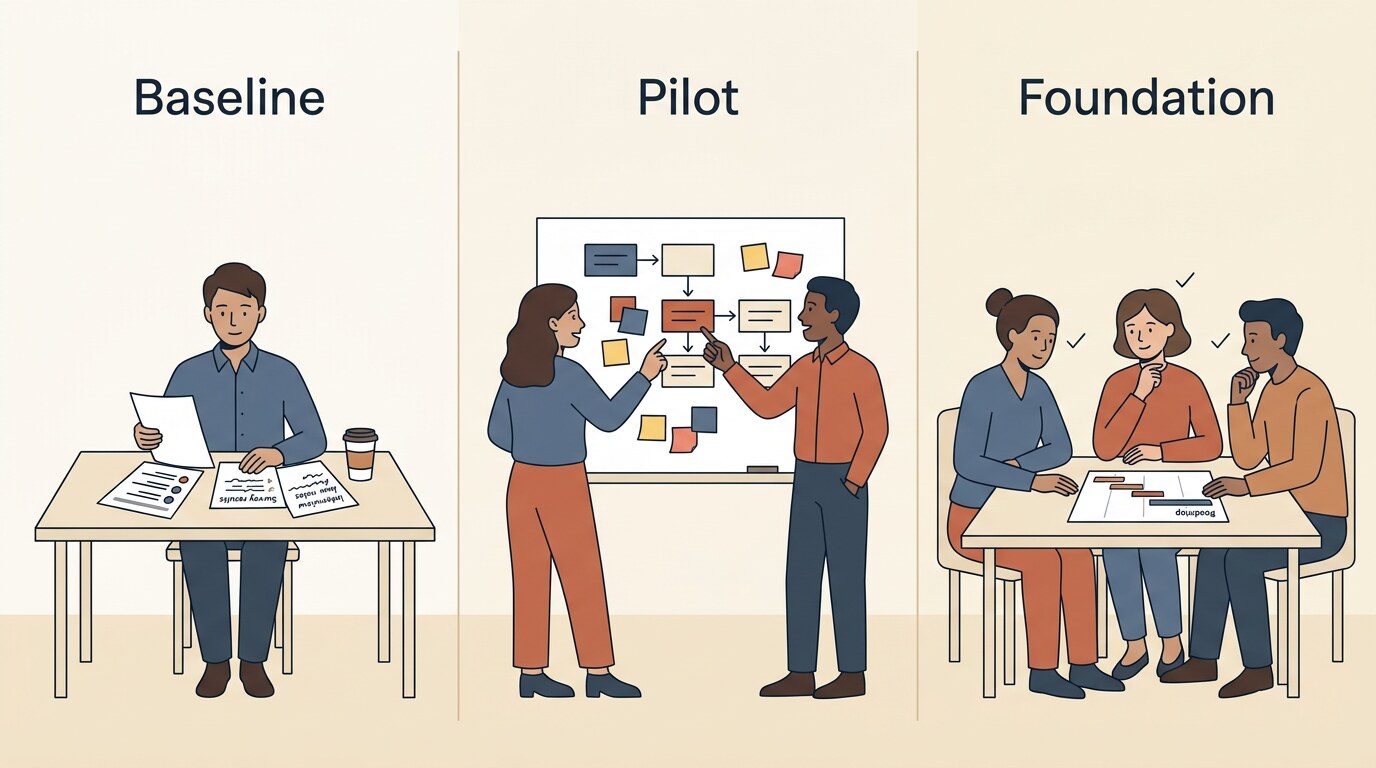
Phase 0: Baseline
Before anything else, you need to understand where you are. This involves two connected assessments.
AI Literacy assessment. Not all teams are at the same level. Some people are just getting familiar with the basics: how to provide good context, how to write an effective prompt. Others have moved further and work in Project mode, setting parameters and instructions that apply across the whole team. More advanced users are creating custom SKILLS, integrating their AI tool with Google Drive, internal systems, or communication platforms. You need to know where your team stands today — what capabilities to look for, and in which direction to develop them.
Process and use case assessment. A use case is a concrete, practical example: the specific steps in a workflow where AI is being used — or could be used — by a particular team on a particular task. For example: automatically summarizing customer emails in support, generating a first draft of a proposal in sales, analyzing data in finance. More teams already have informal use cases than leadership usually realizes. The job here is to surface them, identify the gaps, and understand where it's genuinely worth starting.
A short survey combined with targeted interviews gives you everything you need. Don't skip this phase.
Phase 1: Pilot
The pilot phase is where the substantive work begins. The core activity is process analysis — going end-to-end through key workflows and identifying where AI creates genuine leverage.
This is where people with process analysis experience are invaluable. You're not looking for where AI could theoretically be used. You're looking for where inserting AI into an existing workflow reduces problems and friction, saves meaningful time, or improves quality (however obvious that may sound) in a way people will actually notice and sustain.
Here's a concrete example from our work with clients. In one team, tasks were frequently handed over verbally — in the corridor, in passing. The result was predictable: incomplete information, different interpretations, errors from the very start. AI turned out to be an excellent tool for creating precise task descriptions: we set up a shared Project folder in the AI tool, defined parameters, standards, and what to avoid. The change in that team's process was tangible and measurable.
The output of Phase 1 is your Use Case Database — your organization's living inventory of AI applications, classified by team, implementation status, and potential for use across other departments. From that inventory, you identify quick wins: use cases with high benefit and low complexity that build visible momentum early. These matter psychologically as much as operationally.
Phase 1 Wrap-Up
By the end of the pilot, you should have a clear picture of your current AI Literacy level and process landscape, Version 1 of your Use Case Database, a handful of quick wins already in production, and a department-level roadmap for what comes next. This is your foundation. Everything that follows builds on it.
The Four Non-Negotiables
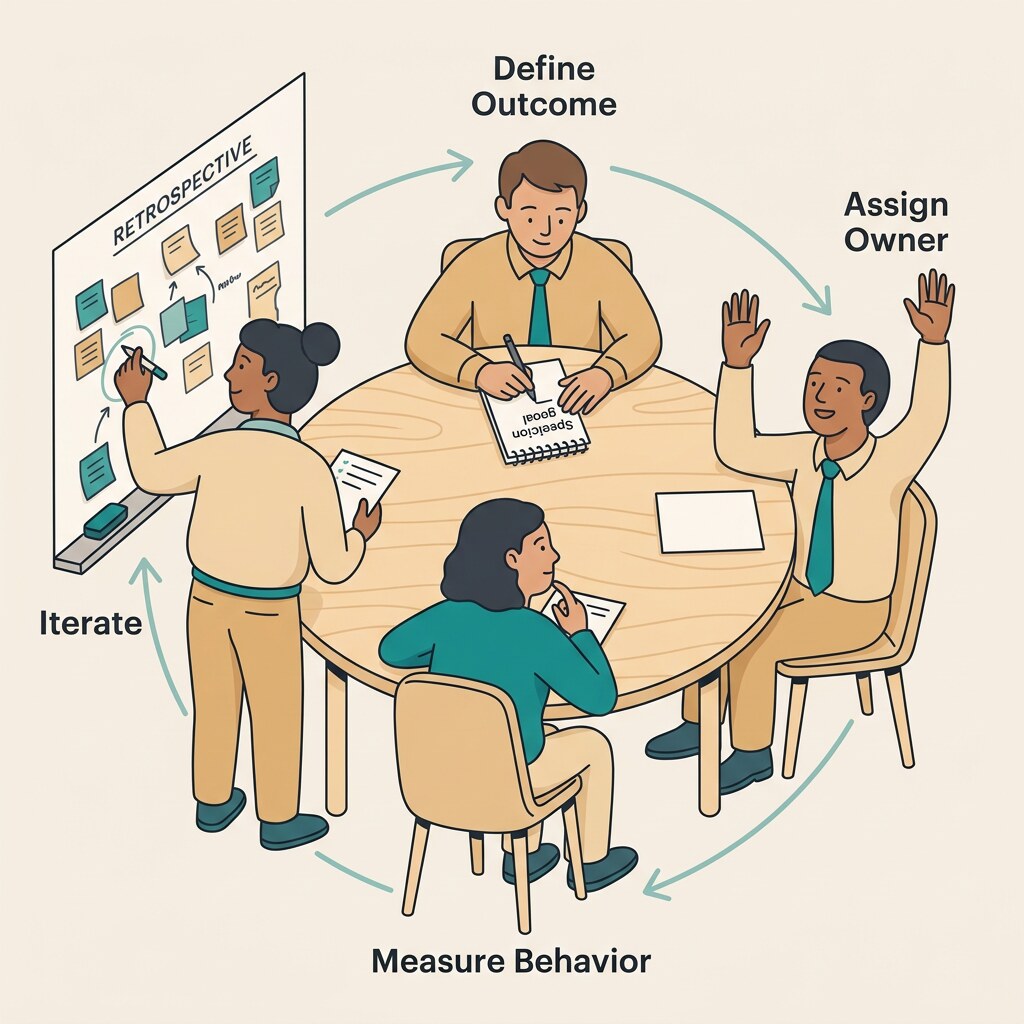
From the PM side, four things every AI adoption initiative needs — regardless of size, sector, or budget.
1. A properly defined outcome. Not "use AI more." Something concrete: "over 80% of the organization uses it on a daily basis", or "we actively use AI in the 7 most important processes in the company", or "the Sales team has a shared Project folder in ChatGPT with common instructions, ensuring standardization". The more specific, the more useful.
2. A single owner. Not a team. A name. Someone who wakes up thinking about this and has the authority to move things forward.
3. Behavioral measurement. Track what actually changed, not just who logged in. Are people reaching for AI in the workflows you targeted? Are the processes genuinely shifting? Login metrics are a vanity signal. Behavior change is the real indicator.
4. Iteration built in. Treat week four like a sprint retrospective, not a finish line. What worked? What needs adjusting? What's the next use case to tackle?
AI Adoption Is Organizational Change
This is ultimately what separates initiatives that stick from those that quietly fade. AI adoption isn't a technology project — it's an organizational change project that happens to involve technology. And organizational change follows the same rules it always has.
You need structure. You need ownership. You need to measure the right things. And you need the discipline to iterate rather than declare victory too early.
How you prioritize which use cases to tackle first — and how you capture what you learn along the way — are two things that make the biggest practical difference. Both deserve their own treatment, and we'll get to them.
AI may be a relatively new phenomenon, but transforming a business in response to new technologies and innovations is not. The companies that have navigated similar shifts successfully before did so with clear structure, good practices, and discipline. The same ingredients work here. Apply them, and successfully embedding AI in your company isn't a matter of luck. It's a matter of approach.
Frequently Asked Questions
What is the biggest reason AI adoption fails? The most common reason is the absence of project structure: no clearly defined outcome, no single person accountable, and no measurement of actual behavior change. Teams start with enthusiasm but without a framework to sustain it, and the initiative gradually fades.
Who should own AI adoption in a company? One person — not a committee or a working group. The owner needs both the authority to drive decisions and enough proximity to day-to-day work to understand where AI can genuinely help. In most organizations, this sits well with a project manager, operations lead, or a senior champion from within the business.
How do you measure AI adoption success? Not by login counts or usage statistics. The real measure is behavioral change: are the workflows you targeted actually different? Concrete outcome metrics — time saved on a specific task, error rate reduction, standardization achieved — are far more meaningful than platform dashboards.
How long does an AI adoption project take? A well-structured pilot typically runs 6–10 weeks: 2 weeks for baseline assessment, 4–6 weeks for process analysis and quick win implementation, and a wrap-up session to establish the roadmap. This is enough time to produce measurable results and a solid foundation — without overcommitting before you know what works.
Do we need external consultants for AI adoption? Not necessarily — but be selective if you do. The space is new and many consultants are there because of the hype rather than real implementation experience. The most effective model we see is a hybrid: an external consultant working part-time within a joint team alongside your internal champions and subject matter experts. Internal knowledge combined with external structure tends to outperform either alone.