
Let me tell you a story from one of my early projects that changed how I think about project management forever.
One of my first big projects was a cost optimization initiative at the biggest oil refinery in the region. Huge chemical production facilities. Pipes going in all directions. We traveled by car from one area to another. I never thought these things were so massive!
The project itself was exciting. Great engineers, great team. Interesting work — people, processes, optimizing distillation columns, managing oxygen levels in furnaces to improve combustion efficiency, analyzing heat exchanger performance. Cool stuff! Motivation was through the roof!
We did our work really diligently. I achieved what I thought was perfect project management. Detailed process mapping. Thorough interviews. Cost-Benefit Analysis of potential opportunities.
But...
My boss was furious. Yelling. Swearing. I found myself working until 3 am trying to make it better — which still wasn't enough. It was beyond my capabilities. I had not experienced so much stress in my career at that time.
Why? Because the business goals of my employer were different. We were consultants. We had promised savings. Not deliverables.
That's when I learned the painful lesson: perfect project management doesn't guarantee perfect business results.
Why Business Acumen is the Missing Knowledge Area
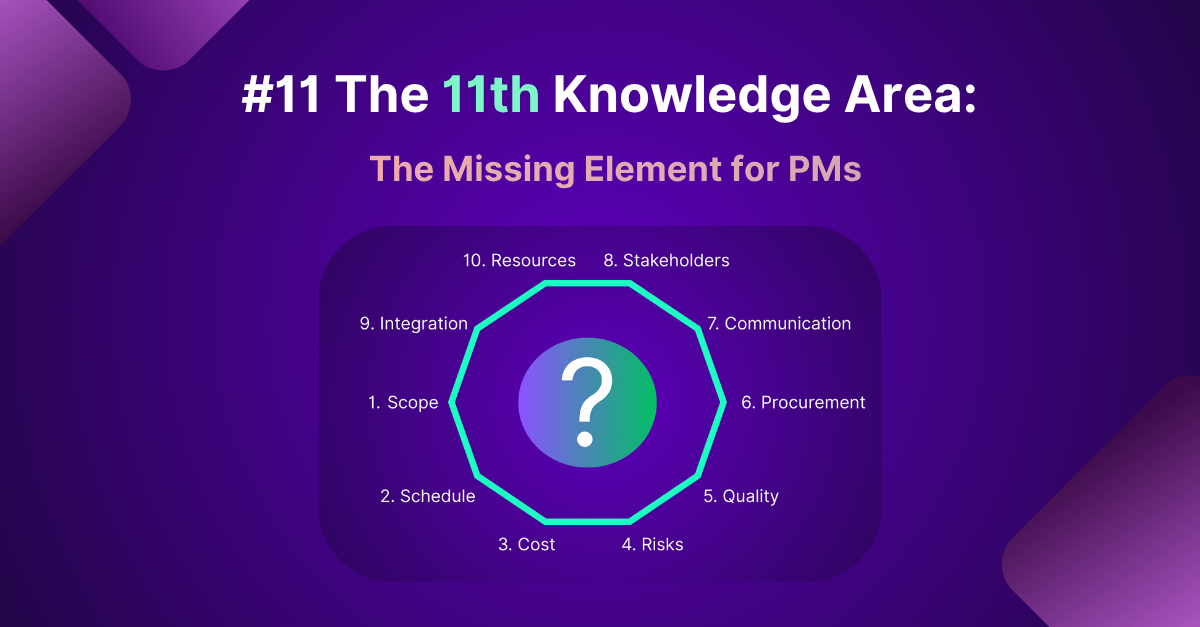
We all know the traditional knowledge areas: Scope, Schedule, Cost, Quality, Resources, Communications, Risk, Procurement, Stakeholders, and Integration. The big 10. They form the foundation of solid project management.
But here's the truth: they're not enough. You can master all 10 and still fail to deliver what the business actually needs. That's why Business Acumen is the missing 11th piece.
Without it, you're managing deliverables — but not necessarily delivering value. Business Acumen aligns you with the same professional management skills that business leaders use. While executives focus on moving the company forward, PMs with business acumen ensure projects do the same — not just delivering outputs, but driving the business agenda.
Consider how the two big players define projects. PMI recently changed its definition exactly in that direction — to highlight the ultimate purpose of generating business value: "A project is a temporary endeavor undertaken to create a unique product, service, or result that delivers value."
PRINCE2 had the better definition already, aligned to that point from the beginning: "A project is a temporary organization that is created for the purpose of delivering one or more business products according to an agreed Business Case."
Both definitions point in the same direction. The output is not the goal. The value is.
What Business Acumen Actually Means in Practice
Senior management uses specific concepts, tools, and techniques to make decisions. When PMs understand and can apply these same tools, they can actively participate in strategic discussions and contribute meaningfully to management decisions.
Make-or-Buy Decisions: Should we build in-house or outsource? This requires understanding fixed vs. variable costs and strategic control — not just delivery logistics.
Cost-Benefit Analysis: Quantifying financial impact. Not just "this is good," but "this will save $X or generate $Y revenue." The kind of language that actually moves senior stakeholders.
Scenario Analysis: What if demand spikes 20%? What if a key supplier fails? Building scenarios with different assumptions and their financial implications — before they happen.
Customer Segmentation: Which customer groups are most profitable? Which have the highest lifetime value? How do we prioritize when resources are limited?
Testing Effectiveness: A/B testing, usage metrics, conversion rates. How do you prove a feature or process actually works — not just that it was delivered?
These are the same tools business leaders use to move the company forward. When you have them in your toolkit, you're speaking the language of leadership.
How Business Acumen Helps a PM
Here's the practical problem: sometimes we get projects without clear reason or justification of what we're trying to achieve. Or the reason is trivial and superficial. That happens more often in bigger companies and corporations.
PMs who have been at the table with senior management — and know their drivers, motivations, and what keeps them awake at night — are more effective in two directions:
Top-Down: Strategy Cascading
Simply: you will know how to better steer the project work if you know the business reasons, situations, and constraints behind it. The strategic intent behind it all.
There's a military rule: "Execute the commander's intent." That means when you're on the ground and something happens, you can't have your sponsor next to you every time. But if you understand the bigger mission, you know what the right call should be. You execute the commander's intent even when the commander isn't there.
Bottom-Up: PM Know-How Into Action
When you're able to connect the dots, you can provide the PM technical perspective on how to execute in a way that actually gets the needed results.
Or if the strategy falls short on realism, you can provide the necessary challenge to the upper level. Sometimes the best thing to do is show the elephant in the room.
Furthermore, even when the strategy makes sense, you can sense early on if results are starting to drift from the goal. You can raise a hand earlier. That's not possible if you're clueless about their strategic expectations.
What Should You Do?
Ask questions. Get curious. Get business curious. Don't just ask "What do you want?" Ask "Why does this matter to the business? What happens if we achieve this? What happens if we don't?"
Immerse yourself: read company reports, attend town halls, talk to sales and finance teams, follow industry news. Build a mental model of how value flows through the business — not just how projects get delivered.
Business Acumen is what business leaders use to drive the company forward. As PMs, we need it too to ensure our projects do the same.
Because great project management is not enough. We need great project results. Make Business Acumen your 11th knowledge area.